Blog

Nick Bonitatibus
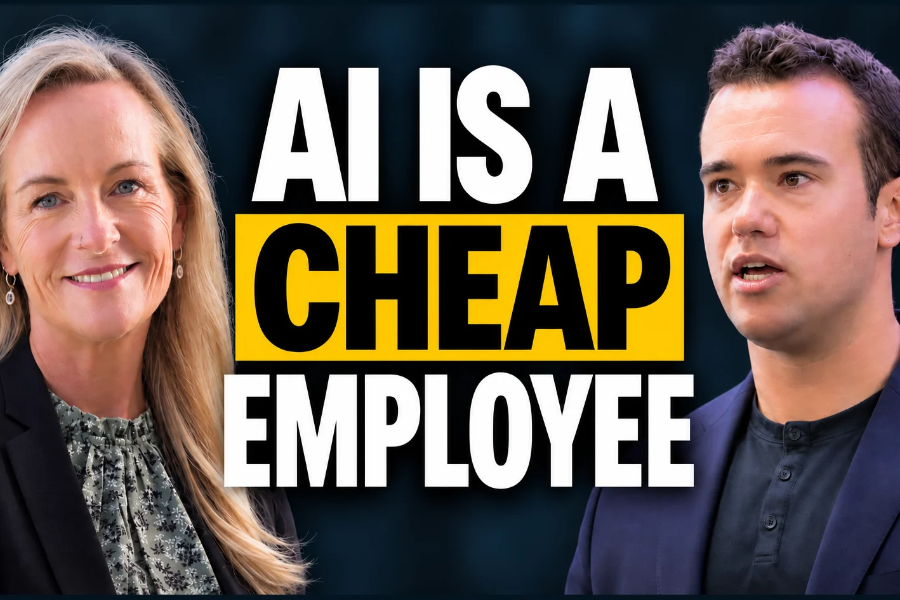
AI is becoming increasingly accessible to home care agencies, but understanding how to apply it effectively in daily operations remains a challenge for many business owners.
For Jen Krum, a registered nurse and owner of Experience Professional Care Solutions in Bozeman, Montana, AI has become a practical tool for simplifying workflows, supporting employees, and improving operational efficiency.
In a recent interview with Nick from Digital Champions, Jen shared how her agency is integrating AI into its operations, the challenges encountered along the way, and the lessons learned from developing custom AI solutions.
Watch the video here.
Jen's experience with AI began with exploring ChatGPT and identifying ways it could support everyday business activities.
Initially, her team used AI for simple tasks such as drafting emails, organizing information, and answering internal questions. Over time, these experiments evolved into more structured applications.
The agency began developing customized AI agents equipped with internal policies, job descriptions, operational procedures, and other relevant resources.
Instead of repeatedly providing the same business context, employees could use these systems to access information and complete tasks more efficiently.
Jen compared the process to training a new employee. AI requires clear instructions, relevant resources, and defined responsibilities to produce reliable results.
This approach has allowed her team to incorporate AI into increasingly complex workflows while maintaining consistency with established agency processes.
One of the most significant projects Jen discussed was a custom quote generator designed to simplify how her agency responds to prospective clients.
Experience Professional Care Solutions offers a range of services, making pricing more complex than applying a single standard rate.
Previously, employees had to consider different service options, pricing structures, and client circumstances when preparing quotes. This created opportunities for inconsistencies and required additional time to verify information.
Using Claude, Jen developed a tool that organizes the agency's pricing rules into a structured system.
The quote generator allows employees to enter relevant client information and generate customized quotes based on established pricing guidelines.
Jen also used AI to help configure an automated workflow through Microsoft Entra and the agency's Microsoft environment. Completed quotes are transferred into a shared email account as drafts, allowing employees to review and send them to prospective clients.
The system includes different communication templates depending on the inquiry source, such as a family member or professional referral partner.
For Jen, the value extends beyond reducing administrative work. The tool provides employees with a more consistent process while reducing the need to repeatedly consult management about pricing scenarios.
However, she emphasized that developing the system required substantial time, testing, and adjustments before it was ready for use.
Another area where Jen's agency has implemented AI is after-hours communication.
The agency previously relied on a traditional 24/7 answering service. It has since adopted an AI-powered solution through Zingage to assist with after-hours calls.
According to Jen, the system has delivered results comparable to, and in some cases better than, the previous human answering service.
The solution integrates with WellSky, allowing scheduling-related updates and call information to flow into the agency's existing operational software.
Jen also highlighted the system's ability to manage multiple calls simultaneously, which can be particularly useful when several scheduling issues occur at once.
However, implementation has required ongoing refinement.
She recalled an instance when the AI agent congratulated an employee who called to resign without notice. Although the response was conversationally appropriate in certain contexts, it did not align with how the agency wanted that situation handled.
The team subsequently adjusted the AI's instructions.
This example highlights an important consideration: AI systems still require monitoring, feedback, and clear operational guidelines, particularly when handling sensitive employee or client interactions.
Introducing AI across an organization is not always straightforward.
Jen explained that employees responded differently when the agency began implementing AI tools.
Some were immediately interested in exploring the technology, while others were hesitant to change established processes.
To address this, Jen encouraged employees to experiment with specific applications relevant to their responsibilities.
In one instance, she assigned AI-related tasks to an employee who had been particularly resistant to adoption.
Over time, employees began recognizing how the tools could help with everyday activities, from drafting professional communications to managing more complicated administrative processes.
Today, Jen reports that everyone on her team uses AI to some degree.
Her experience suggests that adoption becomes easier when employees see how a tool addresses an existing challenge rather than viewing it as technology being introduced for its own sake.
Throughout the conversation, Jen and Nick emphasized that effective AI implementation requires more than simply providing employees with access to a platform.
The quality of an AI system's output depends partly on the instructions, resources, and context it receives.
Jen shared several practices her agency has developed:
The discussion also addressed limitations such as AI-generated inaccuracies and the possibility of losing important context during lengthy conversations.
Nick emphasized the importance of maintaining a reliable source of information that AI tools can reference rather than depending entirely on conversational memory.
For home care agencies, these considerations are especially relevant because operational decisions may involve sensitive client information, employee matters, and financial processes.
One of the central themes of the interview was that AI adoption does not need to begin with a complex system.
Jen encouraged other home care agency owners to start with a small project or an existing operational challenge.
That might involve improving an email workflow, organizing internal information, or examining a repetitive administrative process.
As employees become more familiar with the technology, they can gradually explore more advanced applications.
Her experience also demonstrates the importance of distinguishing between immediate improvements and longer-term investments.
Simple tasks may benefit from AI relatively quickly, while developing custom tools and automations can require significant upfront effort.
The potential benefits depend on whether those systems are reliable, maintainable, and genuinely useful to the business.
Jen's experience provides a practical example of how AI can support home care operations when introduced with a clear purpose.
Her agency has used AI to help standardize client quotes, support after-hours communication, organize internal knowledge, and reduce repetitive administrative work.
At the same time, implementation has involved employee training, troubleshooting, system testing, and ongoing oversight.
AI has not eliminated the need for human judgment or operational responsibility. Instead, Jen's approach focuses on using technology to support existing processes and help employees work more efficiently.
For home care agency owners evaluating AI, the broader lesson is to begin with a clearly defined business problem, establish appropriate safeguards, and assess whether the solution delivers meaningful improvements.
The most useful AI applications are not necessarily the most advanced. They are the ones that solve real operational problems and fit the way an agency works.
Interested in exploring how AI can support your home care agency?
Join the AI Home Care Society, a community focused on helping home care agency owners learn, share ideas, and explore practical AI applications.
Get the latest insights and blog posts delivered straight to your inbox weekly.
Unlock your potential and start generating leads effortlessly with our proven program.
Schedule A Call