Blog
.png)
Nick Bonitatibus
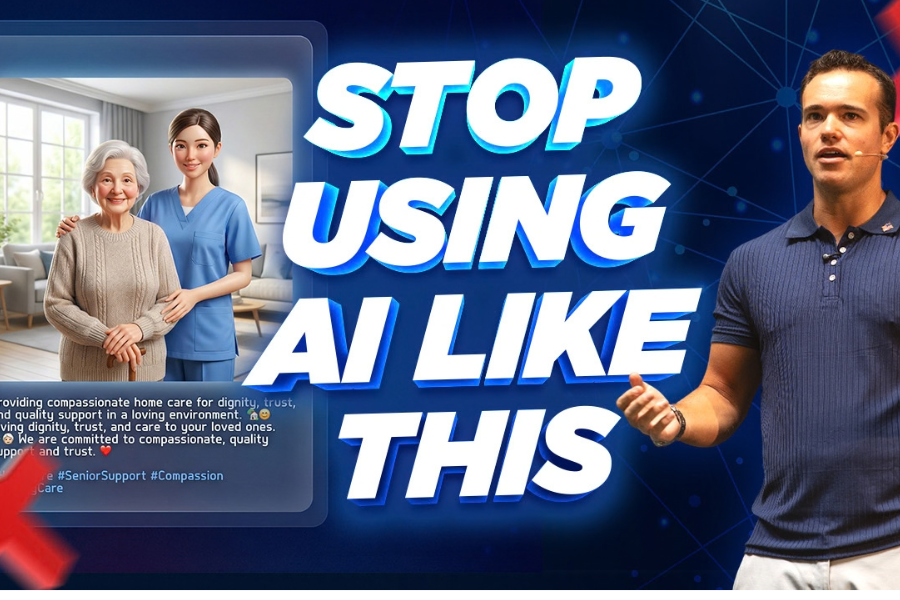
Using ChatGPT for your home care agency’s social media?
Avoid these mistakes. In this video, we explain the common mistakes agencies make when using AI for social media, including relying on robotic content, skipping strong hooks, and forgetting to include real experiences from their team.
You’ll also learn how to use ChatGPT more strategically so your posts feel authentic, build trust, and actually engage the people who matter most to your agency.
Watch the video to discover how to combine AI efficiency with real human storytelling to create better social media content.
Artificial intelligence tools like ChatGPT are quickly becoming part of many businesses’ marketing workflows. They can help generate ideas, draft content, and speed up the content creation process. But using AI the wrong way can actually hurt your social media presence.
Many businesses make the mistake of relying too heavily on AI to do the thinking for them. The result is often generic, obvious AI-generated posts that audiences scroll past without engaging.
If you want to use AI effectively, especially for social media, it's important to understand how to guide it and how to combine it with real marketing strategy.
AI tools are powerful, but they are not replacements for human thinking. The quality of what AI produces depends heavily on the instructions it receives.
When someone simply asks an AI tool to “create a social media post,” the result is often predictable and generic. Without clear direction, AI does not know your brand voice, your audience, or your strategy.
Instead, AI should be treated as a tool that helps execute ideas, not the source of the ideas themselves.
One of the biggest mistakes businesses make is becoming overly dependent on AI to generate all of their social media content.
Posts created this way often feel robotic and lack authenticity. They tend to follow similar patterns, making them easy for audiences to recognize as AI-generated. When that happens, people quickly scroll past them.
Authenticity matters on social media. People engage with real stories, insights, and experiences; not generic marketing language.
Many AI-generated posts share similar characteristics that reduce engagement. These include:
These elements can make posts feel templated rather than thoughtful. Instead of capturing attention, they blend into the background of a crowded social media feed.
For businesses trying to build trust with their audience, this type of content can do more harm than good.
One key element that many AI-generated posts miss is a strong opening hook.
The first line of a social media post determines whether someone keeps reading or continues scrolling. A compelling hook creates curiosity and encourages users to click “read more.”
When people expand a post to continue reading, it signals to social media platforms that the content is engaging. This can help increase reach and visibility.
Without a strong hook, even valuable content can be overlooked.
AI tools do not automatically understand marketing strategy. They do not know your goals, your audience, or the specific purpose behind a post.
Before creating social media content, it’s important to consider questions like:
Providing this context allows AI to generate more relevant and effective content.
The most effective social media content often includes real experiences and stories.
Sharing examples, insights from daily work, or lessons learned adds personality and authenticity to a post. These elements are difficult for AI to generate on its own but can be incorporated when you guide the process.
By combining AI assistance with human insight, businesses can create content that feels natural while still benefiting from the efficiency of AI tools.
Another common mistake is copying and pasting AI-generated content without reviewing it carefully.
Sometimes AI responses include additional notes, instructions, or formatting suggestions meant for the user, not for publication. If these are accidentally posted, they can create embarrassing mistakes.
There have even been cases where published articles included leftover AI instructions because the content was not properly reviewed before being shared.
A quick review step can prevent these kinds of errors.
AI works best when it is used as a collaborative tool.
Think of it as a partner that helps brainstorm ideas, draft content, and improve efficiency. But the final message, strategy, and voice should still come from you.
When used thoughtfully, AI can significantly improve the content creation process. When used carelessly, it can produce generic content that fails to connect with an audience.
AI is changing how businesses approach marketing and content creation. But successful social media still requires strategy, creativity, and authenticity.
Instead of letting AI take over the entire process, use it as a tool that supports your ideas and amplifies your message.
The combination of human insight and AI efficiency is where the real value lies.
Get the latest insights and blog posts delivered straight to your inbox weekly.
Unlock your potential and start generating leads effortlessly with our proven program.
Schedule A Call