Blog
.png)
Nick Bonitatibus
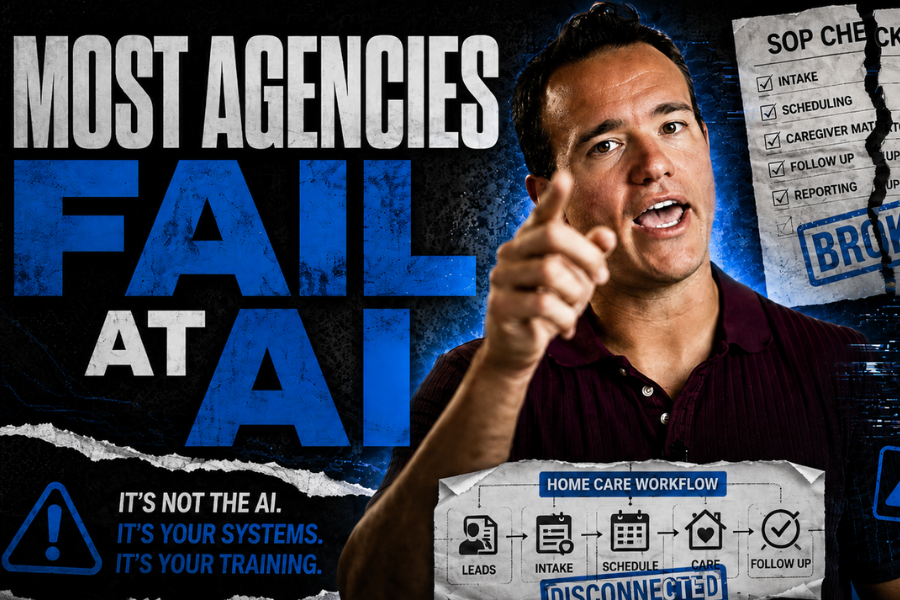
Most home care agencies are going to fail at AI. Not because it doesn't work, but because they never took the time to understand how it works.
AI in home care fails for one reason: owners expect it to perform without ever training it. AI is a brain. It is a person that can be trained. If it doesn't have what you have, how can it make the decisions you want it to make? Give it your process, your standards, and the way you actually think, and everything changes.
Watch or read below.
Because you haven't given it the information. That's it. That's almost always it.
I was on a call with a client recently talking about caregiver matching, and she said to me, "no one can match a caregiver better than me."
My reply: you're wrong. AI is better than you.
I know that sounds harsh. Keep reading, because once I walked her through it she saw it from my side and agreed with me.
So I asked her the real question. Why are you so good at caregiver matching? What is it that you are looking for? What's the process? Skill level. What are they actually capable of doing. Personality type. All these different things.
She had answers for every one of them. She just had never written a single one down.
That's the whole problem. People say AI can't have the intuition to choose. No, it can't, because you haven't trained it. The complexity you think is intuition is actually a process you run so often it went invisible to you.
And here's the part that matters even if you never touch AI: this is still about training employees. If a team member is doing your caregiver matching, how are you training them to know what you know and decide the way you decide? Same problem. Same fix.
Think about it like an employee.
One of the biggest mistakes people make when hiring is expecting the new person to just know what the job is and go do it without any training. AI is the exact same issue. People assume that because it has access to all this information, it's going to be amazing and do exactly what they want. If you don't train it in the process you want it to follow, it won't do the thing you needed it to do.
Now for the pitfalls I see agencies fall into over and over.
Yes. AI is systems. If you don't have systems, AI cannot save you.
I see this constantly. Agencies trying to do more with AI while they don't even have simple automation running, the kind of stuff that has existed for twenty years. When this happens, that happens. When that happens, this happens. AI is more interactive and can run more complex pipelines from one step to the next, but it is built on the same foundation.
Agencies want AI to save them time, and they don't realize that if they just built out real systems and automation, it would work so much better for them. This is the same thing that happens with CRMs. The agency says it doesn't do what I wanted it to do.
It's not a technology problem. It's a system problem.
None of these things work if you don't have proper systems. And if you're somebody that doesn't like systems, it's time to get over that. If you want to master AI, you need to build and create amazing systems.
You document the process your brain is already running without telling you.
Everything you do has a system underneath it. It became second nature, so you stopped noticing. Here's my example.
When I shop for a flight:
Here's the trick, and now I'm revealing my secrets: I pick the window seat that has an aisle seat already taken, because that increases the likelihood that the middle seat stays empty. It works a crazy amount of the time.
Six steps, and I never once thought of it as a process until I said it out loud.
Now do that for the grocery store. Produce section first, frozen stuff last. You have a process for everything you do.
That's the exercise. In your business, in your life, what is the process for the things you do? Because once you have the process written down, AI can eventually run that process.
Not by default, and this is where I see agencies putting themselves at real risk.
Some agencies are throwing information into AI that is not HIPAA compliant. They're sharing personal client information. We can't do this. It will get you in trouble down the line.
To be clear about where the line actually sits: HIPAA covers your clients, not your caregivers. Caregiver skills, availability, personality, and experience are employment information. You can train AI on all of that. It's client health information that has to stay inside compliant tools.
What you can do:
Make sure you know which bucket every tool you use falls into before you paste anything into it.
Because you haven't trained it to. This one is blaming AI when it's actually you.
If the output doesn't sound like you, did you ever build a brand voice for it to work from? If it doesn't follow your process, did you ever give it the process? Whatever you're using it for, it needs a detailed description of what good looks like.
This is where custom AI agents come in. When you build a custom agent, it understands the output you're looking for instead of guessing every time.
This is also where AI skills come in. If you're using Claude, which I highly recommend. I know ChatGPT is the more popular one, and if you've watched my older videos you know I spent a lot of time on ChatGPT. I barely use it now. I use Claude, it's what I'm walking all my clients through, and they love it because they can see the difference.
Because it can only hold so much at once. And the fix is not to keep repeating yourself, it's to store what matters outside the chat.
You know the feeling. You've been going back and forth for an hour, making real progress, thinking this is the coolest thing. Then it hands you something and you go, whoa, whoa, whoa, what? I thought we went over this. The thing I told you not to do, you just did. You're pulling your hair out.
This happened to me enough that I built systems around it. Once you understand why AI forgets, you can save what you want it to know into a separate database that it pulls from and archives. Now every chat starts with everything it shouldn't forget already loaded, and the output gets dramatically better.
It comes down to two things: skills and custom agents. That is the differentiator in how you use AI, and it's what we're building inside the AI Home Care Society.
That's the question I actually want you asking. Not what can AI do for my business. What can't it?
The truth is, if it can be done on a computer, it can be done by AI. That's more advanced territory in terms of how you set it up, but so much of what a home care agency does happens on a computer. If all of that can be handled, you get to focus on everything that can't be done on a computer.
AI isn't meant to replace what you're already doing. It fills in all the things you don't want to do and that quietly eat your time. Most owners don't even notice how much time those things take, because it builds and builds. Clear it out and you get the hours back.
And I'll say this plainly: most agencies in this industry think they understand AI and they actually know very little. That's okay, there's a lot to learn. I still feel like I know nothing, because the more I learn the more I realize I don't know. There are things AI can do that you'd never think to ask about, because you don't know they're possible. The more you learn what's possible, the more it does for you.
I have a client named Phil. Apprehensive about AI, doesn't consider himself a techie person. We have a running joke about me handholding him through posting to Facebook.
Here's what he said on a recent call: "I literally would do nothing with AI because I didn't get it and I didn't want to get it. Until Nick, little by little, took my hand and started to unpack what it is, how it works and why it's important. I went from that to someone who can multitask and do it effectively because I have help."
That's the whole thing. Phil didn't need a better tool. He needed someone to unpack it with him, step by step, until it clicked.
That's exactly why I built the AI Home Care Society. AI feels overwhelming, and nobody in this industry is walking home care owners through it in plain language. I've spent the last decade doing that with digital marketing and social media for agencies. This is the same job, new subject.
Can AI really match caregivers better than an agency owner?Not out of the box. It can once you've documented what you actually look for: skill level, capability, personality fit, and the tradeoffs you make between them. The scheduling platforms are building toward this, but they don't have the full complexity yet. Document your criteria now and you're ahead of the curve.
Which AI tool should a home care agency use, ChatGPT or Claude?I use Claude and it's what I teach my clients. The difference shows up in skills and custom agents, which let you save your process, your voice, and your standards so you're not retraining it every chat. ChatGPT is more popular. Claude is what I reach for.
What's the first thing an agency should do before adopting AI?Write down one process you run all the time, start to finish, including the small decisions you make without thinking. Intake, caregiver matching, scheduling, follow-up, pick one. That document is what you train AI on, and it's what you train new team members on too.
Is AI going to replace my office staff?No. AI is not meant to replace what you're already doing. It handles the computer work that quietly eats your team's day so they can spend that time on the parts of home care that can only be done by a person. The agencies getting it right are freeing people up, not cutting them.
If you want to stop guessing at AI and start building the systems, skills, and custom agents that make it work in a home care agency, that's what the AI Home Care Society is for. Live coaching, training programs, and a community of home care agency owners figuring this out together.
Go to AIHomeCareSociety.com and come learn with us.
Let's Grow Together!
Get the latest insights and blog posts delivered straight to your inbox weekly.
Unlock your potential and start generating leads effortlessly with our proven program.
Schedule A Call